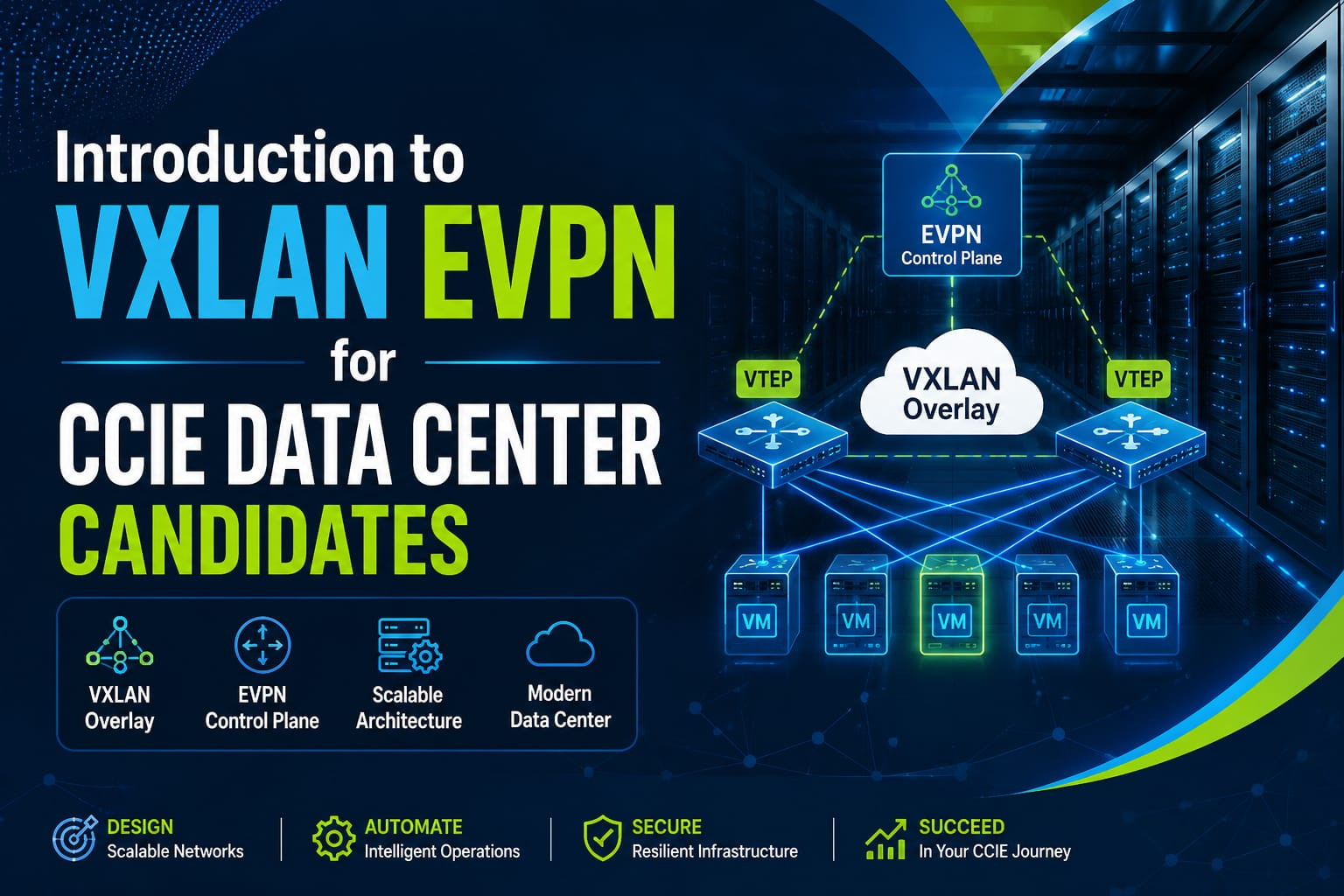
Explore VXLAN EVPN concepts for CCIE Data Center preparation, including architecture, overlays, scalability, and networking basics.
Introduction to VXLAN EVPN for CCIE Data Center Candidates is essential for networking professionals aiming to master modern data center technologies and scalable network architectures. As organizations increasingly adopt virtualization, automation, and cloud-based infrastructure, engineers must understand advanced overlay technologies that support flexible and efficient environments. For professionals who want to pursue CCIE Data Center training, learning VXLAN EVPN has become a critical step toward building expert-level networking skills.
This technology enables scalable multi-tenant designs, seamless workload mobility, and improved operational efficiency across modern infrastructures. Understanding VXLAN EVPN not only strengthens certification preparation but also equips candidates with practical knowledge required to design, deploy, and troubleshoot next-generation data center networks successfully.
What is VXLAN?
Virtual Extensible LAN (VXLAN) is a network virtualization technology designed to overcome the scalability limitations of traditional VLANs. Traditional VLANs support approximately 4,096 segments, which becomes insufficient for modern large-scale data centers and multi-tenant environments.
VXLAN addresses this challenge by extending Layer 2 networks over Layer 3 infrastructure using encapsulation techniques.
Key Benefits of VXLAN:
- Supports millions of logical network segments
- Enables workload mobility across data centers
- Provides scalable multi-tenant environments
- Improves network flexibility and expansion capabilities
- Supports modern cloud and virtualization requirements
VXLAN creates overlay networks that sit above the physical network infrastructure, allowing organizations to scale without redesigning the underlying network.
Understanding EVPN
Ethernet Virtual Private Network (EVPN) acts as the control plane for VXLAN deployments. While VXLAN provides encapsulation, EVPN handles route advertisement, endpoint learning, and efficient forwarding decisions.
EVPN replaces older flood-and-learn mechanisms with a more intelligent control-plane approach.
Advantages of EVPN:
- Reduced network flooding
- Faster convergence times
- Better scalability
- Improved traffic optimization
- Simplified operations
By combining VXLAN with EVPN, data center networks become more efficient and easier to manage.
Why VXLAN EVPN Matters for CCIE Data Center Candidates
VXLAN EVPN has become a core topic in modern enterprise and service provider environments. Candidates pursuing expert-level certifications must understand not only the concepts but also implementation and troubleshooting techniques.
Important reasons to learn VXLAN EVPN include:
1. Industry Adoption
Large enterprises, cloud providers, and managed service providers increasingly use VXLAN EVPN for scalable architectures.
2. Lab Exam Relevance
Many CCIE Data Center lab scenarios require strong understanding of overlays, segmentation, and automation-driven designs.
3. Modern Network Design Skills
Organizations demand engineers who understand software-defined networking and scalable architectures.
4. Automation Integration
VXLAN EVPN environments integrate well with automation frameworks and programmable infrastructures.
VXLAN EVPN Components Explained
Understanding the architecture requires familiarity with multiple building blocks.
| Component | Function | Importance |
| VTEP (VXLAN Tunnel Endpoint) | Encapsulates and decapsulates VXLAN traffic | Critical for overlay communication |
| Underlay Network | Physical IP transport network | Provides connectivity foundation |
| Overlay Network | Logical network built on top of underlay | Enables segmentation |
| BGP EVPN | Control plane protocol | Handles route exchange |
| Spine-Leaf Architecture | Modern data center topology | Supports scalability |
Each component contributes to building scalable and resilient data center environments.
Spine-Leaf Architecture and VXLAN EVPN
Modern data centers commonly use Spine-Leaf topologies because they support predictable latency and high scalability.
Spine Layer:
- High-speed switching layer
- Connects all leaf switches
- Provides transport backbone
Leaf Layer:
- Connects servers and endpoints
- Performs VXLAN encapsulation
- Acts as VTEP devices
This architecture enables efficient east-west traffic flow, which is essential in modern workloads.
Control Plane vs Data Plane
Candidates preparing for advanced networking roles must differentiate between these concepts.
Data Plane Responsibilities:
- Packet forwarding
- Traffic encapsulation
- Transport delivery
Control Plane Responsibilities:
- Route exchange
- Endpoint discovery
- Policy distribution
EVPN primarily operates in the control plane while VXLAN handles data-plane encapsulation.
Common VXLAN EVPN Use Cases
Multi-Tenant Data Centers
Organizations hosting multiple customers need isolated environments.
Virtual Machine Mobility
Applications can move across servers while maintaining network consistency.
Data Center Interconnect
Businesses can extend workloads across multiple locations.
Cloud Infrastructure
VXLAN EVPN supports large-scale cloud environments efficiently.
Challenges Candidates Should Understand
Learning VXLAN EVPN involves several complexities.
Design Complexity
Overlay networks introduce additional abstraction layers.
Troubleshooting Difficulties
Multiple control and data planes increase troubleshooting complexity.
Learning Curve
Candidates often struggle with protocol interactions.
Automation Requirements
Modern deployments increasingly require scripting and programmability knowledge.
Understanding these challenges prepares candidates for real-world scenarios.
Tips for Learning VXLAN EVPN Faster
Build Hands-On Labs
Practice deployments in simulated environments.
Learn BGP Fundamentals
EVPN heavily relies on BGP concepts.
Understand the underlay first
Strong IP routing fundamentals simplify overlay learning.
Practice Troubleshooting
Focus on packet flows and route verification.
Study Real Deployments
Enterprise architectures provide useful context.
Future of VXLAN EVPN in Data Centers
As organizations continue migrating toward hybrid cloud and automated infrastructures, overlay technologies will remain critical.
Future trends include the following:
- Greater automation integration
- Increased multi-cloud adoption
- More software-defined networking deployments
- Expanded AI-driven operations
Network engineers who understand these technologies will remain highly valuable.
Conclusion
VXLAN EVPN has transformed modern data center networking by providing scalable, flexible, and efficient architectures. For professionals pursuing expert-level certifications, developing strong expertise in overlays, control planes, and modern designs is essential. Whether preparing for lab environments or enterprise deployments, investing time in learning these technologies creates long-term career advantages.
A structured CCIE Data Center course combined with hands-on practice can significantly improve understanding and exam readiness while building practical skills for modern infrastructure environments.